TWO:On the 12th of March, 1839, Mr. Villiers again moved for a committee of the whole House to take into consideration the Act regulating the importation of foreign corn, and the Manchester delegates were once more in London to watch the progress of events. On this occasion the House again decided, by 342 votes to 195, not to take the subject into consideration. The defeat was of course expected; but the members of the Association immediately assembled again, and issued an address to the public, in which for the first time they recommended the formation of a permanent union, to be called the Anti-Corn Law League, and to be composed of all the towns and districts represented in the delegation, and as many others as might be induced to form Anti-Corn Law associations, and to join the League. Delegates from the different local associations were to meet for business from time to time at the principal towns represented; but in order to secure unity of action, it was proposed that the central office of the League should be established at Manchester, and that to its members should be entrusted the duties of engaging lecturers, obtaining the co-operation of the public press, establishing and conducting a stamped periodical publication, and keeping up a constant correspondence with the local associations. The delegates then parted, becoming so many local missionaries for spreading the doctrines of the new crusade. The Manchester Association had issued a large number of handbills and placards. It now began to publish more largely and systematically a series of pamphlets. Among these were "Facts for Farmers," in which it was shown to demonstration that, whatever might be the interest of the landowners, their tenants had no real share in the benefits of their monopoly. The cheapness of the publications secured them an extraordinary sale wherever political questions were discussed. Mr. Villiers's speech, extending to thirty-two closely printed pages, was sold at three halfpence; Mr. Poulett Thomson's speech, occupying sixteen pages, at three farthings. When the appeals were made to the electors of the kingdom during the height of the agitation, as many as half a million each of the more popular tracts were issued at a time. In accordance with the resolution passed by the League at its formation in London, a fortnightly organ of the new movement was started on the 16th of April. Its title was the Anti-Corn Law Circular. A preliminary address announced that a copy of the paper would be regularly forwarded to every newspaper, review, and magazine in the empire. The first number contained a "Modern History of the Corn Laws," by Richard Cobden, with various information on the progress of the movement. Meanwhile the work of lecturing went on. Free Trade missionaries were dispatched to all parts, and, to the annoyance of the landlords, even preached their obnoxious doctrines to audiences in smock frocks in the agricultural towns and villages, where the views of the country party had hitherto held undisputed sway. Among the most remarkable of these speakers was Colonel Perronet Thompson, who, by his celebrated "Catechism of the Corn Laws," and his other writings, had done perhaps more than any other man of his time to confute the fallacies of the Protectionist party. The clear and terse style, the shrewd reasoning power, the apt and homely illustration, and, above all, the hearty sincerity and good temper of this remarkable man, were equally acceptable among the most refined or the least educated audiences.
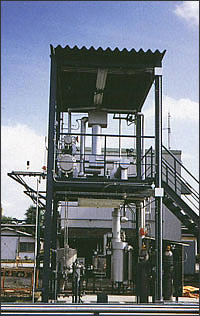
Great attention is recently being paid to global environmental issues, and it is now conceivable that companies will need to treat used solvents themselves. In consideration of this kind of social issue, we have developed a “membrane separation type solvent dehydration system,” which uses a polyimide membrane with superior dehydration properties developed by Ube Industries, Ltd. in combination with our own distillation and concentration technology that has resulted in solvents being more easily recovered.
THREE:[See larger version]
- 1Under the distillation system, even in case of azeotropic solvent compositions, this system which remove water vapor by the polyimide membrane will easily dehydrate.
- 2In comparison with the distillation system, it significantly saves on use of steam.
- 3Dehydration can be performed through merely supplying evaporated vapor to the membrane module and maintaining the differential pressure between the permeable side and the impermeable side.
- 4Solvent purity of 99.9% or more can be achieved by carrying out dehydration with a polyimide membrane only.
- 5The polyimide membrane has superior heat and solvent resistance. Therefore, the vapor permeation system reduces contamination of the membrane and thus extends its life.
THREE:Amongst the novelists of the later period of the reign we may name Horace Smith, author of "Brambletye House," etc.; Leigh Hunt, the poet, author of "Sir Ralph Esher;" Peacock, author of "Headlong Hall;" Beckford, author of the wild Eastern tale of "Vathek;" Hamilton, author of "Cyril Thornton," etc.; Maturin, author of "Melmoth the Wanderer," etc.; Mrs. Brunton, author of "Discipline," "Self-Control," etc.; and Miss Ferrier, author of "Marriage" and other novels of a high order. Jane Austen (b. 1775; d. 1817), author of "Pride and Prejudice," "Mansfield Park," "Sense and Sensibility," etc., all distinguished by the nicest sense of character, was far above any of these, and ranks with the foremost of our writers of fiction.
The aromatic polyimide membrane is highly permeable to water vapor but less permeable to vapors of organic compounds such as alcohol etc.
THREE:
- 1 Recovery of the detergent solvent Recovery of the cleaning solvent such as electronic parts industry, precision instrument industry.
- 2Solvent recovery and the refinement Solvent recovery and the refinement such as chemical industry, an industry of medical supplies, food industry, the fermentation industry.
THREE:Philip V. of Spain died on the 9th of July, and his son and successor, Ferdinand VI., showed himself far less anxious for the establishment of Don Philip in Italy¡ªa circumstance unfavourable to France. On the contrary, he entered into separate negotiations with England. A Congress was opened at Breda, but the backwardness of Prussia to support the views of England, and the successes of the French in the Netherlands, caused the Congress to prove abortive.
Acetone, ethanol, methyl ethyl ketone, butanol, isopropyl alcohol, ethyl acetate, methyl isobutyl ketone, others (including hexane and toluene).
